



Bastian Becker, founder of SciLove. Photo: Bastian Becker
Bastian Becker has been working in research for 15 years. He is currently a postdoctoral researcher at the Institute for Social Sciences at Humboldt University in Berlin. His idea to develop a tool for research and literature review arose out of chaos: email alerts, open browser tabs, forgotten articles.
“SciLove solves exactly this problem,” Mr. Becker explains in an interview. “You select the journals you want to follow, go through their latest articles one by one, and save the relevant ones in a personal library. That way, you don’t miss any new articles — and it takes less time, too.” The website, which is also available as a downloadable app, was launched in February 2026. Since then, nearly 2,000 researchers from over 70 different countries have registered.
The functionality behind the app
A swipe interface presents a variety of information in a compact format. The title, abstract, and an AI-generated summary of the main findings can be swiped to the right or left, depending on where your focus of interest lies. This allows users to quickly get an overview of current publications. There’s also a match feature for networking: If there’s mutual interest, users can connect directly through the app and expand their network. “This is especially valuable for doctoral students and postdocs: Those who are still building their networks can find people working on the same questions—regardless of hierarchies or conference budgets. If you don’t want to use this feature, you can simply turn it off.” Another feature allows early-career researchers to add a job market paper to their profile, even if it hasn’t been published yet. This gives them greater visibility and allows them to connect with others early on.
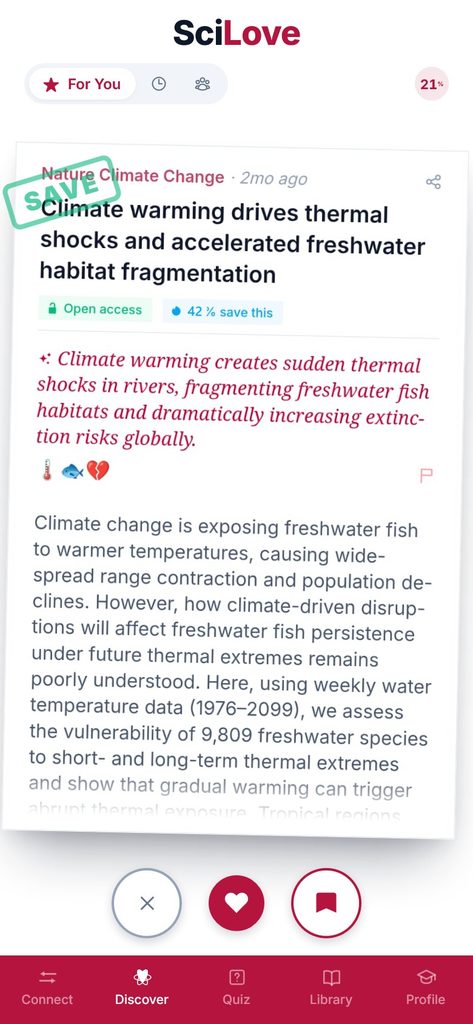

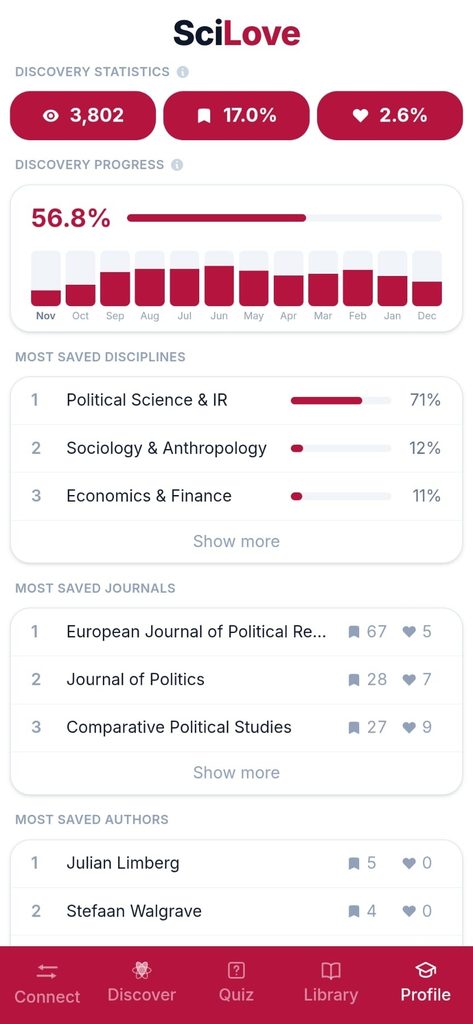
From the swipe feed (left) to a weekly trivia quiz (center) to your own user profile (right). SciLove offers a variety of app features.
SciLove now includes over 3,400 journals from 16 different disciplines. To curate the journals, Bastian Becker first uses the SCImago Journal Rank, or SJR for short. In addition to the 200 leading journals in each discipline, users of the tool can recommend other academic journals. These are then evaluated for quality and credibility. “I review every submission myself, paying particular attention to ensuring that it is not a so-called ‘predatory journal,’” emphasizes Mr. Becker. His goal is to reach academic communities beyond Europe as well.
„My goal is for SciLove to become as second nature to researchers as checking their email inbox – only much more enjoyable.“
The feed for SciLove users is based on the journals they have selected themselves. The homepage is powered by an algorithm that takes into account individually specified keywords and the publication date. Users who prefer open-access articles can choose to have these displayed on the homepage as well. “At the same time, SciLove deliberately encourages users to think outside the box. On the one hand, the algorithm mixes in articles that are often archived together—which means that articles from related subject areas are also displayed. On the other hand, the feed occasionally displays specially marked articles from journals that users do not follow but whose content is highly relevant. This allows users to discover research they would never have specifically sought out.” The algorithm can also be deactivated if desired.
“My goal is for SciLove to become as second nature to researchers as checking their email inbox—only much more enjoyable. For me, it’s less about reaching a specific number and more about broadening the community: more disciplines, more countries, and researchers who don’t just try out SciLove but use it on a long-term basis,” the postdoc concludes the interview. “This year, colleagues—including those at scientific conferences—have recommended this new app called ‘SciLove’ to me on several occasions. They obviously didn’t realize that the developer was standing right in front of them. I can hardly imagine a nicer compliment.”