


Participants of the Constituency Days (c) Hallo Bundestag

Participants of the Constituency Days (c) Hallo Bundestag

Participants of the Constituency Days by Hallo Bundestag (c) Hallo Bundestag
A democratic society cannot be taken for granted. Strengthening democracy is therefore just as important as the task of regularly reminding people of their right to co-determination. Many are often not even aware that they have the right to participate and shape society – or they are convinced of the exact opposite: they feel powerless and abandoned by politicians. Not infrequently, this leads them to fall prey to conspiracy theories or radical views.
The non-profit association Demokratie Innovation (Democracy Innovation) is doing something to counter this. As part of the “Hallo Bundestag” (Hello Bundestag) project, it brings together 25 randomly selected people with MPs from their constituency on so-called Constituency Days, thereby attempting to strengthen the relationship between politics and society.
And the Constituency Days actually work, as a research team from the Humboldt Governance Lab (GovLab) at the Humboldt-Universität zu Berlin, led by Prof. Dr. Heike Klüver, has found: Political trust, self-efficacy, and the willingness to participate increased after the events, while openness to conspiracy narratives decreased (results). The GovLab combines social science research with societal dialogue and, together with practical partners, develops evidence-based approaches to strengthening democratic resilience.
“This project is a prime example of what the Humboldt Governance Lab stands for: we do not just want to analyze societal challenges, but rather develop and scientifically evaluate concrete solutions to strengthen democracy together with practical partners. Only when we have an evidence-based understanding of which measures strengthen trust, political participation, and democratic resilience can successful approaches be scaled in the long term.”
— Prof. Dr. Heike Klüver, Director of the Humboldt Governance Lab
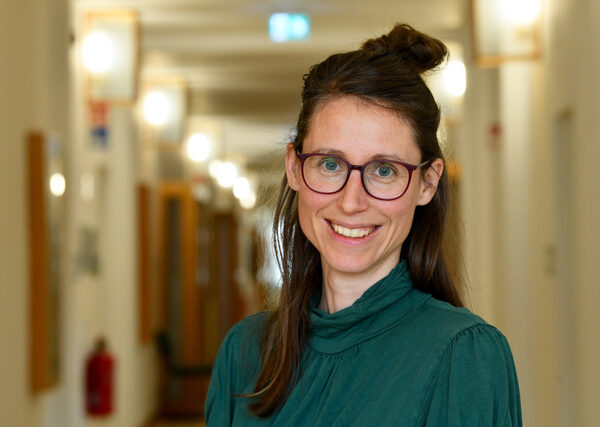
Portrait of Prof. Heike Klüver

Prof. Dr. Heike Klüver, Director of the Humboldt Governance Lab (c) GovLab
The scientists evaluated the effectiveness of the Constituency Days during the very first phase of the project. Now, they are also providing scientific support and evaluation for the 2026 to 2029 project phase.
We spoke with Jainaba Kurz, Policy and Research Advisor at “Hallo Bundestag”, to find out more about the project and the collaboration with the Humboldt-Universität zu Berlin.
Through ‘Hallo Bundestag’, you facilitate dialogue between the public and members of the Bundestag. What was the specific catalyst for launching this project?
The association Demokratie Innovation, which is behind the Hallo Bundestag project, wants to strengthen our representative democracy. Because it is under pressure: anti-democratic forces are growing stronger, our society is polarizing, and many people feel powerless in the face of the global situation.
With Hallo Bundestag, we want to make democracy tangible. With our one-day dialogue format, the ‘Constituency Day’, we show that we are not as far apart as we sometimes think. This works best when a group of randomly selected people who are as diverse as possible sit down at the same table with MPs from different parties. Through this dialogue, which we guide constructively thanks to professional moderation, trust grows once again – both in politics and in social cohesion.
Enabling as many people as possible to have this experience – especially those who are withdrawing from politics – is what drives us.
Jainaba Kurz, Policy and Research Advisor at Hallo Bundestag (c) Hallo Bundestag

Jainaba Kurz, Policy and Research Advisor at Hallo Bundestag (c) Hallo Bundestag
The pilot project is already behind you. What was the most important or perhaps even the most surprising insight from this first phase?
It was very moving to see how people blossom when you give them the space to do so. We got to know very different individuals, each bringing their own story. What was particularly remarkable was that many of them regained a tangible idea of what a positive future could look like.
The MPs also highly appreciated the format, even though some of them were skeptical at first. They were surprised by the constructive atmosphere and the diversity of the selected participants. They rarely reach such diverse groups.
The fact that our personal experience here aligned with the research results was very encouraging for us.
You have brought the HU Berlin’s Humboldt Governance Lab on board for the evaluation for the second time now. Why was it so important to you not to just evaluate the project based on a ‘gut feeling,’ but rather to utilize solid, accompanying scientific research?
For us, the rule is: we work in an innovative, self-critical, learning, and curious manner. Impact measurement is one of our top credos. The scientific support from the Humboldt Governance Lab helps us to systematically measure the impact of our project and uncover potential for improvement that we could not identify on our own.
Furthermore, it helps us immensely in our external communication to be able to refer to reliable research findings. This builds credibility. After all, with our ‘Constituency Day’ dialogue format, we want to bring a democratic innovation into the Bundestag and establish it throughout Germany. Scaling it up like this would not be sustainably possible without accompanying scientific research.
How have you experienced the collaboration with the team at the Humboldt Governance Lab? And how do you manage to transfer scientific insights into your daily project work?
The collaboration at the interface of science and practice is incredibly valuable to us. Too often, both fields work in their own silos, even though both sides learn enormously from each other. At the same time, we notice that the researchers also benefit from our practical experience.
Of course, external accompanying research requires precise coordination, regular exchange, and a certain amount of organizational effort. But we are convinced that this form of evidence-based impact measurement is indispensable for civil society projects. The Humboldt Governance Lab in particular pursues an approach here in which research and social practice are closely intertwined.
To what extent has the scientific perspective of the Humboldt Governance Lab helped you to strategically develop the follow-up project?
In the predecessor project, we were able to show through GovLab’s research that Constituency Days work. A particularly important insight was that the effects are significantly stronger when MPs from different parties are involved. That is why we now ensure that at least two Members of the Bundestag (MdBs) attend each Constituency Day.
In addition, we brainstormed together on how we can think bigger in the new project phase. Now, we are not only investigating how Constituency Days affect the participants themselves, but also how these experiences ripple out into their social networks and constituencies.
In addition to the research, a cooperation like this involves quite a bit of administration and legal framework. We at Humboldt-Innovation had the pleasure of supporting you through this. How did you experience our collaboration?
We are in very close and warm contact with our liaisons. Both sides bring great expertise to their respective fields, and it is fun to bring these different skills together. Administration is not always easy, of course. However, since we work with sensitive data ourselves and have to meet high requirements, we are used to structured processes.
Looking to the future: What is your vision for ‘Hallo Bundestag’ in the coming years, and what role does continuous scientific support play in that?
At Hallo Bundestag, we want to establish the Constituency Day as a long-term democratic innovation. Already, 89 members of the Bundestag have expressed interest in holding a Constituency Day in their constituency. That is a strong signal. The scientific insights from the Humboldt Governance Lab are central to our efforts. They help us not only to understand how and why the format works, but also to convince political decision-makers, funding partners, and the public of this approach in the long term.
Hand on heart: What advice would you give to other initiatives or NGOs that are still hesitant to integrate scientific expertise into their projects?
We started with our first Constituency Day in 2021. Now, we are planning over 50 Constituency Days across Germany. This is a major step forward for us. Without scientific backing, scaling up would likely have been neither possible nor sustainable. Therefore, we would clearly recommend that other initiatives involve scientific expertise as early as possible. Collaborations with institutions like the Humboldt Governance Lab specifically help not just to implement projects, but to actually understand their impact and develop them further in the long term.
Thank you for the interview!


Founded and led by Prof. Dr. Heike Klüver, the Humboldt Governance Lab combines excellent social science research with societal dialogue, evidence-based policy advising, and the development and evaluation of concrete measures to strengthen democratic resilience. Under the guiding principle “Better Evidence. Stronger Democracy.”, the GovLab works with partners from politics, civil society, and business to develop evidence-based approaches to strengthening democracy, and actively injects scientific findings into public debates.